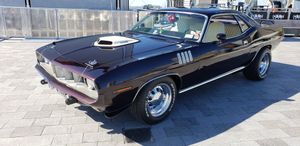
The 1969 Road Runner retained mostly the same look with a few exceptions like taillights, grille, side marker lights, optional bucket seats, and new Road Runner decals.
The new Barracuda was completely restyled and no longer shared any kind of sheet metal with the Valiant, although under the skin the platform was still shared with that car. The engine bay was widened so the big-block 383 would fit.
The 1970 Road Runner arrived with new front and rear looks. Updates included a new grille, leather seats, hood, front fenders, quarter panels, single-piston Kelsey-Hayes disc brakes, and even non-functional scoops in the rear quarters.
The 1971 Road Runner was part of the Satellite group and its bodywork was completely changed to a more rounded "fuselage" design. It included a steeply raked windshield, hidden cowl, and deeply inset grille and headlights.
The Barracuda received only minor styling changes for 1968 – the big news was under the hood. The 225-cube slant six continued as the entry-level powerplant, but even the base V8 was significantly upgraded, with a huge bore increase resulting in 318 cubic inches, still with a 2-Bbl carburetor.
The 1972 Road Runner was nearly identical to the 1971, but with a few exceptions like new grille design, new taillights designed to match the new aerodynamic look of the grille, and new side marker lights.
Interesting to note, the steering wheel was from the Vega GT and did not sit well with Corvette enthusiasts, therefore this was the only year for such wheel. Sales were at an all-time high this year.
The 1977 Corvette did receive minor changes, but they were more about branding than styling or performance. “Sting Ray” was dropped, and a new crossed flags badge adorned the front of the hood between the headlights as well as on the fuel filler door.