

The collector car market, in your inbox
Classic car news, hand-picked vehicles, and auction coverage. Choose what lands in your inbox.
An auction listing is a sales document. It is written, edited, and photographed by the party who benefits when the number goes up. That does not make it dishonest — the best auction houses and the best consignors are scrupulous — but it does mean the listing is an argument, not a report.
The photographs get the attention and the catalog copy gets the headlines. The money, though, is made and lost in the sections most bidders scroll past: the condition grade, the documents folder, the reserve status, the estimate range, and the terms you agree to the second you register. Here is how experienced buyers read each one.
Condition Grades Are a Language, Not a Compliment
Most serious listings assign the car a condition number, usually on the one-to-four scale popularized by Hagerty’s valuation tools. Those grades have specific meanings, and they are not interchangeable with enthusiasm.
- #1 Concours. The best in the world. Perfectly clean, with mirror-like paint and chrome, correct materials expertly fitted, and no dust or dirt anywhere. This is a trailered car.
- #2 Excellent. Could win a local or regional show. Flaws exist but require close inspection to find, and the car drives as a new vehicle of its era would.
- #3 Good. Drives and runs well, but is not daily transportation. Passersby will not notice defects, and some incorrect parts may be present.
- #4 Fair. A driver, with flaws visible to the naked eye — pitted chrome, a chipped windshield, minor dents, tired paint or a deteriorating older restoration. Nothing major is missing.
Here is the part that costs people money: in almost every listing, that grade is assigned by the consignor or by the auction house’s own specialist. It is not an independent inspection. Treat it as a claim to be verified, not a finding. The distance between a genuine #2 and an optimistic #3 on the same car is routinely tens of thousands of dollars.
Condition is also separate from originality. A superbly finished restomod can be a #1 for workmanship and still trade in a completely different market from a correct, original-spec example. If you want to understand how the finish-quality end of the scale is actually assessed, our breakdown of what concours judges actually look for is a useful calibration tool.
What a Real Condition Report Actually Contains
A condition report is not three adjectives and a gallery of beauty shots taken at golden hour. A useful one gives you evidence you can check:
- Paint depth gauge readings across multiple panels, which reveal filler and respray work
- Panel gap and shut line photos, straight on and in flat light
- Undercarriage images covering floors, frame rails, rockers, and suspension mounting points
- A cold-start video with audio, not a walkaround of an already warm engine
- Honest documentation of leaks, seepage, and surface rust in that model’s known trouble spots
- Glass date codes, tire date codes, and battery age
- A plain list of deviations from factory specification
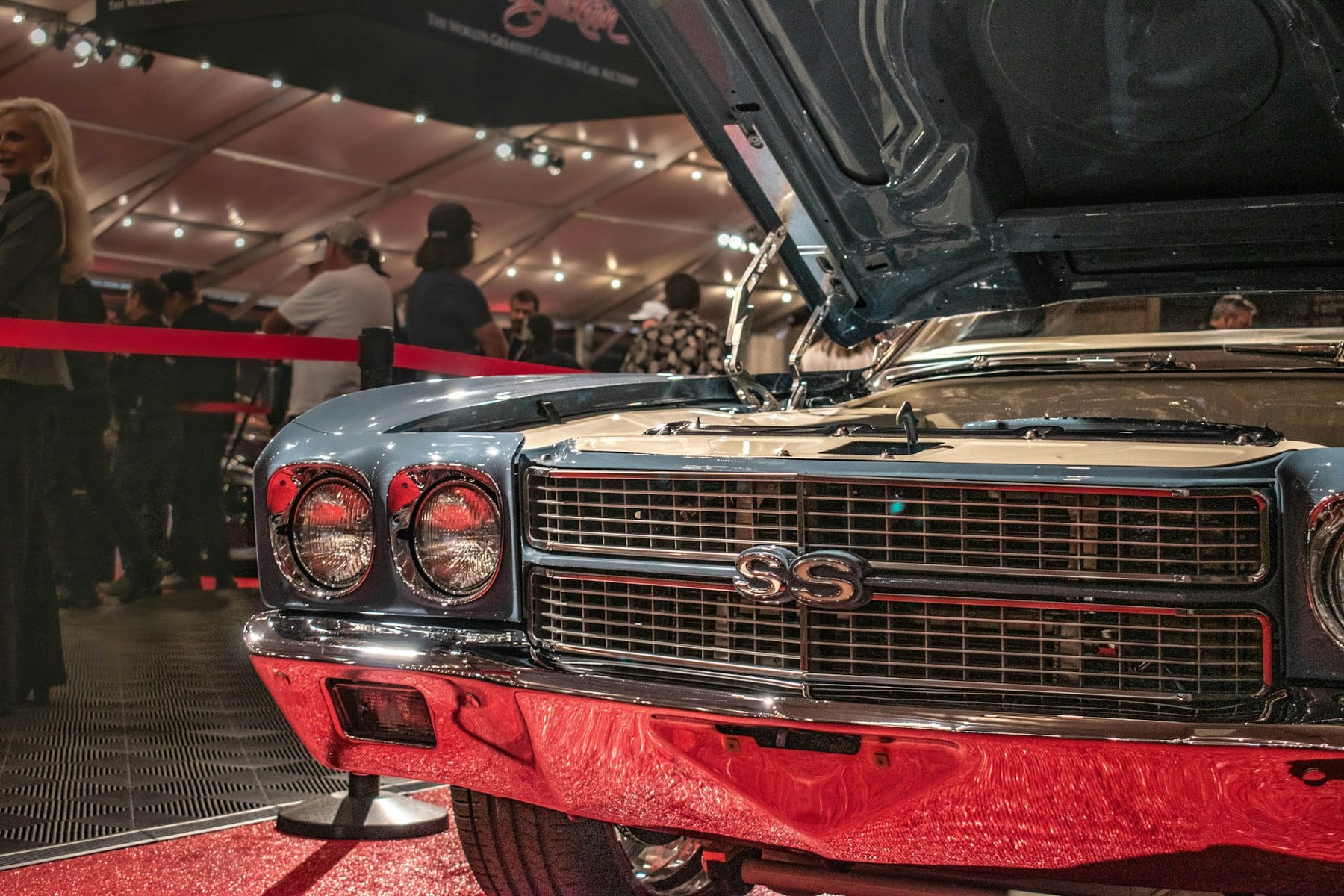
Absence is information. Hagerty puts it bluntly in its auction buying guidance: if a listing says nothing about a car being numbers-matching, you can generally assume it is not. Apply the same logic everywhere else. No undercarriage photos usually means the underside does not photograph well. No cold-start video usually means it does not start cold well. Sellers with clean cars and complete files are, as a rule, eager to show you both.
Provenance Is Paperwork, Not a Story
Provenance is the documented chain of evidence connecting the car in front of you to the car the factory built and the history the seller describes. A compelling narrative is not provenance. Paper is.
Four categories matter, and strong listings address all four:
- Factory documentation. A Marti Report for Fords, Pontiac Historic Services documentation for Pontiacs, build sheets and broadcast sheets, the original window sticker, and the dealer invoice.
- Identity hardware. The VIN or chassis plate, cowl and trim tags, data plates, and engine, transmission, and rear axle stampings and casting numbers — photographed, not merely described.
- Chain of ownership. Prior titles, registrations, bills of sale, and correspondence that account for the years between the factory and today.
- Use history. Service records and receipts, restoration invoices naming the shop, race entries and results, concours awards, and period magazine features.
Learn the hedge words, because they do real work. Believed to be, reported to be, said to have been, and per the previous owner all signal that the auction house could not verify the claim and is protecting itself. Documented history that never names the documents is not documentation. Restored regardless of cost with no invoices is a sentence, not a receipt. None of these are automatically disqualifying, but every one of them should be priced as unverified rather than as fact. Our guide to researching a classic car’s history before you bid covers how to chase these down yourself.
Numbers Matching Deserves Its Own Paragraph
No phrase in a listing is stretched further. To one seller it means the original engine block that left the factory in that car is still in it. To another it means a correct, date-coded replacement. To a third it simply means the engine is the right family and displacement. Those are three very different cars at three very different prices.
Ask which one it is, in writing, and ask for photographs of the stampings and casting numbers. If the answer is vague or the photos never arrive, you have learned something. We have broken this down in detail in numbers-matching explained and in a closer look at why the phrase can cost you thousands.
The same caution applies to badges. Tribute cars, clones, and correctly built recreations can be terrific cars and honest value, but only when they are described as what they are. A well-known example of the gap between a real car and a tribute is laid out in our look at what tribute muscle cars are really worth.
Reserve Status Tells You How to Bid
Reserve is not a detail. It changes the entire structure of the sale.
- No reserve. The car sells to the high bidder, whatever that number turns out to be. Genuine no-reserve lots are where the real opportunities live, and where sellers accept real risk.
- Reserve. A confidential minimum agreed between the consignor and the auction house. Bidding below it does not produce a sale, no matter how spirited the room gets.
- Reserve met, or on the market. The moment this appears, the car is selling. In a live sale, watch for the auctioneer to announce it mid-lot; the bidding dynamic usually changes immediately.
- Provisional, or sold subject to seller confirmation. The high bid is recorded and the seller gets a window to accept it. A large share of collector cars trade this way, in the office, after the block.

Online, add one more variable: the closing rule. Some platforms end at a hard time and some extend the clock whenever a late bid lands. That single line in the terms determines whether sniping works at all. For the mechanics of both formats, see reserve vs. no reserve explained and how car auctions work.
Estimates Are Marketing With a Range Attached
A pre-sale estimate is the auction house’s published opinion of where a car should land. It is built from comparable sales and condition, and it is also negotiated with the consignor, who has opinions of their own about what the car is worth. That negotiation is why estimates skew optimistic on fresh consignments and why they sometimes look conservative on cars the house badly wants to sell.
Three things to know before you let an estimate anchor you:
- The low estimate often sits at or near the reserve. When a lot stalls below low estimate, it is frequently a lot that is not going to sell.
- Estimates exclude the buyer’s premium. Nearly always. The top of the range is not the top of your cost.
- An estimate is not an appraisal and it is not a comp. Pull your own recent sold results for the same model, year, spec, and condition grade, and weight sold prices far more heavily than asking prices.
When you see estimate without reserve, read it carefully. It is telling you the range is genuinely a guess and the car is selling regardless of where the bidding stops.
The Fine Print Buyers Skim
The terms and conditions are the part of the listing nobody reads and everybody agrees to. Work through these before you register, not after you win.
- As-is, where-is. Near universal, and it means no warranty, express or implied. Your inspection window closes when the hammer falls.
- Buyer’s premium. A percentage added to the hammer price and kept entirely by the auction house. Live collector car sales commonly sit around ten percent, sometimes with a minimum dollar figure or a sliding scale that steps down on higher-value lots. Online platforms typically charge a smaller percentage with a hard cap. Confirm the exact structure for the specific sale.
- Sales tax and registration. Where you take delivery and where you title the car both affect what you owe.
- Title status. Clean, salvage, rebuilt, bonded, out-of-state, or bill of sale only. Some states will not register a car on a bill of sale alone. Confirm the title is in hand and that the name on it matches the consignor.
- Dispute or arbitration window. Many sales allow only a very short period — sometimes hours — to raise an undisclosed-condition claim. Know the clock before you bid.
- Payment deadline and method. Wire deadlines are often 24 to 72 hours, and card payments are usually capped well below the purchase price.
- Storage and removal. Free storage tends to end quickly, after which daily fees accrue against a car you may not have arranged transport for yet.
- Bid increments and deposits. Registration deposits, bidder fees, and increment jumps can move your bid further than you intended in a fast lot.
Build Your Own Number Before You Bid
The hammer price is never the price. Work backward from what you can actually spend, and do it on paper before the lot comes up.
Say your all-in ceiling is $50,000. A ten percent buyer’s premium on a $41,000 hammer adds $4,100. Sales tax at six percent on that $45,100 adds roughly $2,700. Enclosed transport across a few states is another $1,200 or so. You are at about $49,000 before you have bought a single tire, and cars bought at auction very often need tires, fluids, belts, and a brake service in the first month.
That $50,000 budget supports a hammer bid closer to $41,000 than to $50,000. Write that maximum on the back of your bidder card and do not move it because the car in front of you is red and the room is loud.
Red Flags Worth Walking Away From
- A condition grade with no supporting photography
- No undercarriage images and no cold-start video
- Numbers-matching claims with no stampings pictured
- A recent restoration with no invoices and no shop named
- Documents described as available on request that never arrive
- A seller who answers questions privately but not publicly
- Title status left unmentioned entirely
- Mileage described as showing rather than actual, with no explanation
None of these mean the car is bad. All of them mean the risk sits with you, and the price should reflect that.
The Listing Is Not the Car
Every listing is the seller’s best case, assembled by people who are good at assembling best cases. The bidders who do well over time are not the ones with the sharpest eye for paint. They are the ones who treat a listing as a set of claims, pay full price for the claims they can verify, discount the ones they cannot, and walk away when the paperwork does not match the story.
Do that consistently and the auction stops being a gamble and starts being a market. If you are still finding your footing, start with our tips for first-time auction buyers, our guide to buying your first classic car, and our rundown of everything to know about online car auctions. For a closer read on the listing copy itself, see what to look for and what to ignore.