
The collector car market, in your inbox
Classic car news, hand-picked vehicles, and auction coverage. Choose what lands in your inbox.
Every so often a car surfaces that seems to exist purely to test the boundaries of what's sensible, and this one fits the description. It's a 1930 Rolls-Royce that has been reborn around a 27-liter Merlin V12, the same family of aero engine that carried Britain through the Second World War. Nobody seems entirely sure who built it, or exactly when, which only adds to the appeal.
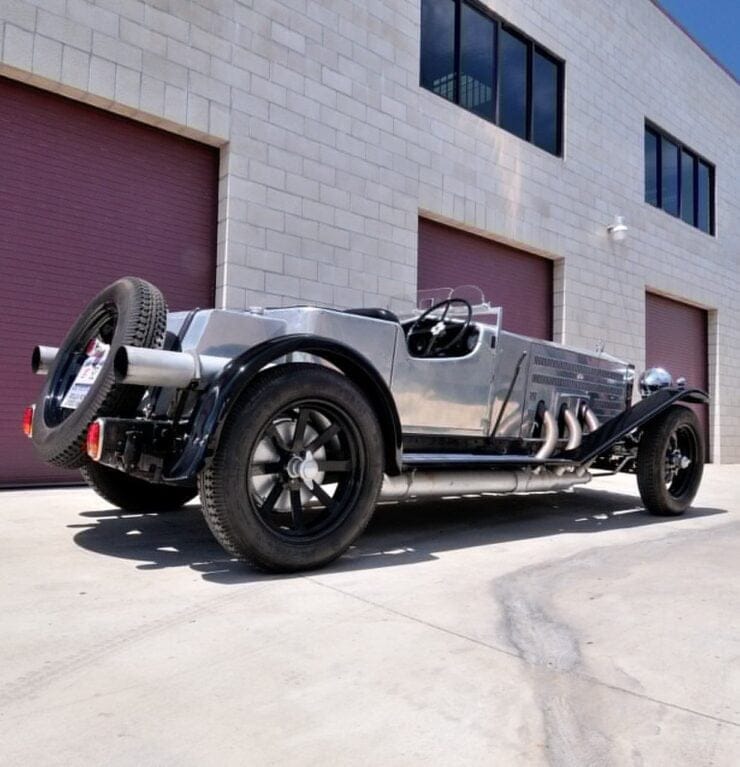
What's clear is that someone took a Phantom II-era chassis and turned it into a two-seat special, then did something genuinely unusual for this breed of machine: they fitted a manual gearbox. Most aero-engined road cars run automatics because a clutch tends to have a short, dramatic life when asked to cope with that much torque. Whoever assembled this one decided to row their own gears anyway.
From the Spitfire to a Two-Seater
The Merlin's story is one of the great gambles in engineering history. Rolls-Royce began the project on its own dime as the PV-12, with no government order to justify it, and the first example came to life on a test stand in late 1933, only months after the death of co-founder Sir Henry Royce. By the mid-1930s the Air Ministry wanted a 300-plus mph single-seat fighter, and the Merlin, named for a small falcon rather than the legendary wizard, was the only engine that could realistically get there.
From there it became a legend. Early versions made around 1,000 horsepower, and as supercharger development advanced under engineers like Stanley Hooker, output kept climbing until late-war variants pushed past 2,000 horsepower. The engine powered the Spitfire, Hurricane, Lancaster, and Mosquito, and when Packard built it under license in Detroit as the V-1650, it transformed the P-51 Mustang into the long-range escort fighter that changed the air war over Europe. Total production across Britain and the United States reached nearly 150,000 units.
There was also a tank-bound sibling. From 1941, Rolls-Royce and Leyland Motors developed the Meteor, a de-rated and naturally aspirated take on the Merlin that put engines failing aero-grade standards to good use in armored vehicles. It shared the Merlin's 27-liter displacement and made somewhere between 550 and 810 horsepower, going on to power Cromwell, Comet, Challenger, and Centurion tanks. Production ran all the way to 1964, outliving the Merlin itself.
Joining an Eccentric Club
Once the war ended, surplus Merlins and Meteors became cheap enough that a small band of enthusiasts started bolting them into road cars. The most notorious is John Dodd's "Beast," which famously landed Rolls-Royce in a trademark dispute, but the fraternity also includes Robin Beech's Handlye Special, Nicholas Harley's Wilkinson-bodied 64GX, Jay Leno's 1934 Rolls-Royce special, and Rod Hadfield's Meteor-powered Chevrolet Bel Air in Australia. This Speed Wagon is the newest name on a very short, very loud list.
What We Know About the Car
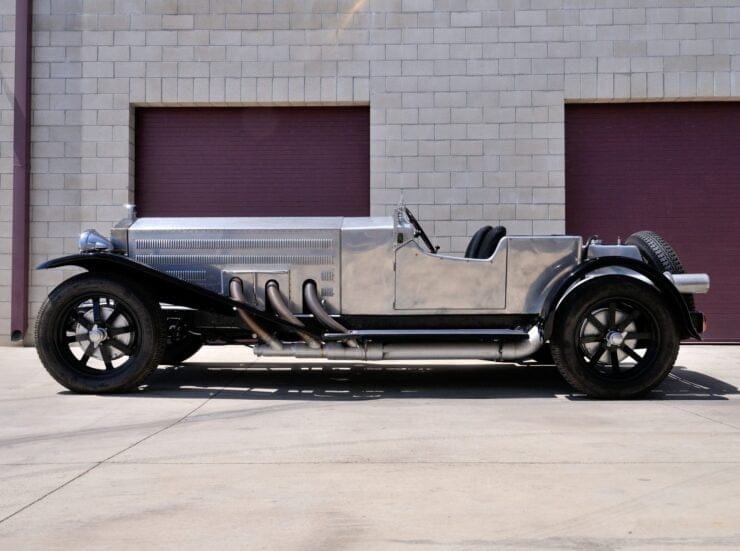
Details on the build are thin, but the hardware tells its own story. The car uses a 1930 Rolls-Royce foundation with a cantilevered chassis stiffened by seven crossmembers, heavy-duty axles riding on semi-elliptical leaf springs, and original Lockheed brakes with finned aluminum drums. It rolls on 24-inch eight-spoke wheels wrapped in Michelin radials, with hand-formed aluminum bodywork finished off by black fenders.
Up front sits the headline act, identified as a Merlin rather than a Meteor. There's no supercharger here, so it breathes naturally through dual brass-bodied twin-throat Zenith carburetors, with twin engine-mounted mechanical fuel pumps, four separate intake manifolds, twin-magneto ignition, a Ki Gas hand primer, and a 15-gallon dry-sump oiling system. Cast-iron manifolds feed a single chamber per side that exits through three six-inch pipes, and drive goes back through a hydraulically operated clutch to that rare four-speed manual.
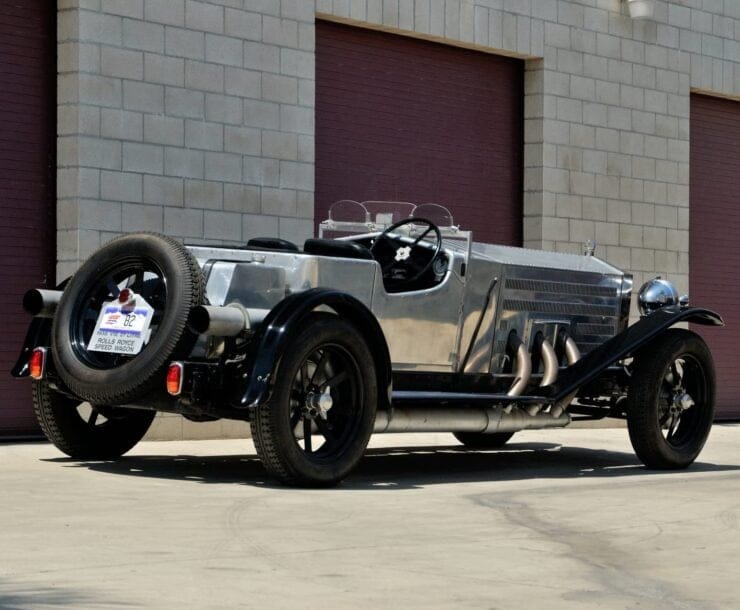
Inside, it's about as focused as it gets: two seats tucked behind a trio of period aero screens, with the essential gauges clustered in a central walnut dashboard. It's a cabin built for noise, wind, and very little else, which is exactly the point.
Headed to Monterey
The Speed Wagon is due to cross the block with Mecum in Monterey, California, this August, where it should be one of the more memorable lots of the week, if only by decibel count. Whoever ends up with it is taking home a genuine piece of mystery, a car that turns a chapter of wartime engineering into something you can, in theory, drive to breakfast.
Source: Silodrome. Images courtesy of Mecum.