
The collector car market, in your inbox
Classic car news, hand-picked vehicles, and auction coverage. Choose what lands in your inbox.
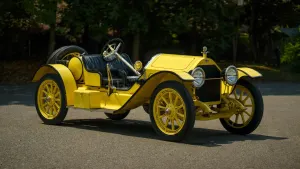
A remarkably documented 1914 Stutz 4E Bearcat is headed to Broad Arrow Auctions for the 2026 Audrain Auction, carrying a $1.75 million to $2 million estimate and a résumé that reads like a condensed history of American collecting. Chassis 2250 has passed through the hands of Winthrop Rockefeller, casino magnate William F. Harrah, James A. Conant, and Richard Losee, yet its story begins with a Rhode Island banker who bought it new more than a century ago. Photo and listing details courtesy of Broad Arrow Auctions.
This is not simply another old yellow speedster. It is one of the scarce pre-1915 Bearcats with a continuous ownership trail from new, supported by period photographs, correspondence, and published accounts. That provenance matters enormously in the rarefied market for early American performance cars, where authenticity and a clean chain of custody can separate a seven-figure landmark from a much more ordinary result.
The American Sports Car Before The Term Existed
Harry C. Stutz earned his company’s reputation at the first Indianapolis 500 in 1911. A hastily assembled Bear Cat finished 11th at an average of 62.375 mph, reportedly completing the race without a mechanical adjustment. The result inspired the slogan “The Car That Made Good in a Day” and gave the new company instant credibility.
The road-going Bearcat distilled that competition formula to its essentials: two bucket seats, a cylindrical bolster fuel tank, a steering-column-mounted monocle windshield, and almost nothing in the way of weather protection. Its 389-cubic-inch Wisconsin T-head four-cylinder produced roughly 60 horsepower, while a three-speed transaxle placed the transmission and differential together at the rear. That layout was remarkably forward-looking, and the Bearcat’s minimal body made its purpose unmistakable.
Motorious has covered the breed before, including a different 1914 4E Bearcat with 72 years of Kelsey-family ownership. A later 1920 Stutz Bearcat shows how the formula evolved while retaining its Indianapolis-rooted identity.
A Honeymoon, A Vanderbilt Cup Winner, And A World’s Fair
Thomas Ives Hare Powel of Middletown, Rhode Island, bought chassis 2250 new in April 1914 and registered it with Rhode Island plate number 51. In 1923, Powel and his new wife, Hope Knight Hodgman, reportedly took the Stutz on their honeymoon. He kept it until 1936, when it was sold to Smith Hempstone Oliver, an important figure in the early Antique Automobile Club of America and Veteran Motor Car Club of America.
Oliver did not treat the Bearcat as static art. He drove it home to New York and used it daily. Later that year, 1911 Vanderbilt Cup winner Ralph Mulford drove the car to victory in a veteran-car exhibition at Roosevelt Raceway. In 1940 it appeared at the New York World’s Fair, where Indianapolis legend Ralph DePalma used it as a pace car for the World’s Fair Grand Prix.
After passing through several East Coast enthusiasts, the Bearcat entered Winthrop Rockefeller’s collection in 1965. Rockefeller restored it in the familiar yellow-and-black scheme and displayed it at his Museum of Automobiles on Petit Jean Mountain. Following Rockefeller’s death, the car joined William F. Harrah’s celebrated collection before James and Dorothy Conant acquired it in 1976.
During three decades with the Conants, the Stutz won an AACA National First Place at Hershey and appeared at the inaugural Meadow Brook Concours d’Elegance. Richard Losee later owned it, and in 2011 Road & Track put the century-old Bearcat alongside a contemporary Corvette—an inspired comparison between two generations of unapologetically American performance.
What Hagerty’s Data Says About The Bearcat Market
Hagerty Valuation Tools records this exact chassis selling for $2.92 million at Pebble Beach in August 2021. Broad Arrow’s current $1.75 million to $2 million estimate therefore sits 31 to 40 percent below that result. That does not automatically mean the Bearcat market has fallen by the same amount: at this level, venue, timing, condition, and the small pool of qualified buyers can have an outsized effect.
The comparable evidence also shows how selective the market can be. Hagerty records the other 1914 4E, chassis 2079, reaching a $2.2 million high bid without selling in September 2024. A 1914 6E Bearcat, by contrast, failed to sell at a reported $330,000 bid earlier that year. The spread is a reminder that “1914 Stutz Bearcat” is not a uniform commodity. Specification, documentation, originality, condition, and ownership history all shape the number.
Chassis 2250 brings an unusually strong combination of those factors. It has the early 4E specification collectors prize, a documented line from its first owner, period competition appearances, major awards, and a roster of recognized custodians. Its prior $2.92 million sale also gives bidders a clear benchmark—even if the next result lands somewhere else.
A Brass Era Benchmark Comes Back To Market
The 2026 Audrain Auction is scheduled for October 2 in Newport, Rhode Island, bringing the Bearcat back to the state where its first owner registered it in 1914. That symmetry is hard to manufacture, and it gives Broad Arrow an evocative setting for one of America’s foundational performance cars.
Modern supercars may overwhelm it on paper, but the Bearcat’s appeal has never depended on modern numbers. It represents the moment when an American manufacturer turned an Indianapolis result into a road car with attitude, simplicity, and speed at the center of its identity. More than 112 years later, chassis 2250 still looks like the definition of purpose—and its next sale will offer a revealing test of what the best Brass Era stories are worth today.