
As the global motorsport landscape continues to evolve, Formula One is drawing renewed attention from manufacturers across the automotive industry. Audi is preparing to challenge established competitors with the backing of the Volkswagen Group, while Cadillac is entering the championship as its eleventh team. Ford has aligned itself with Red Bull, reinforcing its presence at the highest level of racing. Amid these developments, Ferrari remains a constant force, both on the grid and on public roads.
Ferrari’s current road-car lineup reflects a broad approach to performance and design. The range begins with the Roma V8 grand tourer, soon to be followed by the Amalfi. The 296 introduced a Ferrari-branded V6 as a plug-in hybrid mid-engine sports car. Higher up the spectrum are specialty models like the Icona series, the Daytona SP3, the Purosangue V12-powered crossover, and the 12Cilindri grand tourer. The SF90 Stradale sits near the top, with its successor, the 849 Testarossa plug-in hybrid, on the horizon.
Ferrari has also entered a new era of hypercars with the limited-production F80. Designed to commemorate the brand’s 80th anniversary, the mid-engine model follows the LaFerrari but departs from tradition with a plug-in hybrid system centered on a 3.0-liter V6 rather than a V12. That decision has sparked debate among enthusiasts, some of whom question whether a V6 belongs in a flagship hypercar.
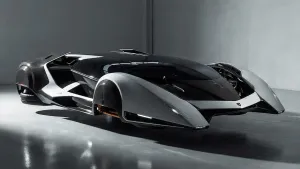
That debate has inspired creative alternatives in the digital design world. One such vision is the unofficial Ferrari MXXE concept, created by virtual artist Rishav Kumar. The digitally rendered hypercar is presented as a tribute to Ferrari’s Formula One heritage rather than a production proposal.
The MXXE concept features dramatic styling cues drawn from open-wheel racing. The front fenders resemble partially exposed wheel covers, while butterfly doors extend into the roof and incorporate both vertical and horizontal glass sections. At the rear, the bodywork blends into an elaborate aerodynamic structure that merges with a large wing.
Despite its futuristic appearance, the MXXE is not imagined as a fully electric vehicle. Visual details suggest internal combustion or hybrid propulsion, including exhaust flames visible at the rear, with outlets integrated into the complex bodywork.
While purely hypothetical, the MXXE concept highlights how Ferrari’s Formula One identity continues to influence designers beyond the factory walls. It also reflects ongoing conversations about performance, powertrains, and tradition as the automotive world moves deeper into hybrid and electrified territory.